

Here’s the thing people get wrong about how I play games.
It’s not that I can’t be competitive.
It’s that I’m not trying to turn every match into a TED Talk about my skill level.
If you drop into my stream expecting elite mechanics, perfect rotations, and a masterclass in “how to dominate,” you’re going to be disappointed pretty fast.
If you drop in expecting conversation, chaos, side comments, random questions, and people steering the vibe more than I do, you’re in the right place.
That difference matters more than people think.
Heads up! Some of these links are affiliate links, which means I may earn a commission at no extra cost to you. I only recommend tools I use or trust.

Winning Is Loud. Learning Is Social.
Gaming to win is about control.
You control the loadout.
You control the pace.
You control the narrative: watch me do something impressive.
Gaming to learn is different. It gives up control on purpose.
It leaves room for people to talk.
It leaves room for mistakes.
It leaves room for someone in chat to say, “Why did you do that?” and for the honest answer to be, “I don’t know, but let’s find out.”
That’s not accidental.
That’s the point.
I respond to what chat is saying with the mic on my HyperX Cloud 3 Wireless Headphones.
The Stream Isn’t a Stage. It’s a Couch.
A lot of gaming content feels like a performance.
Big reactions.
Forced hype.
Everyone pretending they’re one clip away from greatness.
That energy works…for a while.
But if you actually want people to stick around, the dynamic has to change.
I don’t want the stream to feel like you’re watching me.
I want it to feel like you’re sitting next to me.
Talking.
Commenting.
Backseat-driving A LITTLE.
Laughing when things go sideways.
When the chat leads, something shifts.
People stop consuming and start participating.
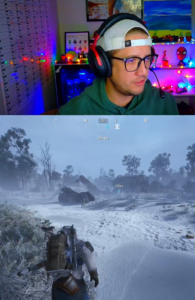
Being “Good” Is a Short-Term Strategy
Here’s a quiet truth about online spaces: skill gets attention, but it doesn’t always build connection.
You can be incredible at a game and still feel untouchable.
Impressive, but distant.
And distance is the enemy of community.
When someone messes up and owns it, chat wakes up.
When someone asks instead of flexes, people respond.
When there’s space for voices besides the streamer’s, things loosen up.
People don’t want perfection.
They want permission to exist.
I keep up with what chat is saying on my Acer Nitro 27″ 300hz monitor.
Letting Go of the Driver’s Seat
Some mornings, I barely lead at all.
The chat decides what we talk about.
The jokes evolve without me.
Someone drops a story, someone else builds on it, and suddenly the game is just background noise.
That’s not a failure of content.
That’s success.
The game becomes the excuse, not the focus.
And honestly? That’s where the internet feels most human.

Attention Has Changed (Whether We Like It or Not)
People don’t show up online to be impressed anymore.
They show up to feel included.
That’s why polished doesn’t always win.
That’s why hyper-produced doesn’t always stick.
That’s why quiet consistency outperforms viral moments over time.
When someone knows what they’re walking into, the same vibe, same openness, same willingness to let things breathe, they relax.
And relaxed people talk.
Talking people return.
Learning Is a Long Game (Which Is Why It Works)
Gaming to learn isn’t about improvement in the obvious sense.
Sure, mechanics get better.
Timing improves.
You stop making the same mistake quite as often.
But the bigger learning is social.
You learn how to listen.
You learn when to talk and when to shut up.
You learn that letting things be messy makes room for other people to matter.
Winning is a spike.
Learning is a slope.
“Slopes don’t look exciting, but they go somewhere.”
I’m learning to play my game on my XBox Elite Wireless 2 Controller.
The Unspoken Agreement
When people hang out consistently, there’s an unspoken deal forming.
“I’ll show up.”
“You don’t have to impress me.”
“We’ll figure the rest out.”
That agreement is fragile.
It only works if you don’t pretend to be above it.
The second someone turns the stream into a pedestal, the room changes.
The second it turns into a conversation again, people lean back in.

This Isn’t Anti-Competition. It’s Pro-People.
I still want to win.
I still lock in sometimes.
I still care.
But winning isn’t the organizing principle.
Connection is.
If the choice is between being slightly better at a game or significantly better at building a room people want to be in, I know which one compounds.
And compounding beats flashes of brilliance every time.
Why This Feels Different (Even If You Can’t Name It)
Nothing about this is flashy.
There’s no “watch me cook” moment.
No manufactured urgency.
No pressure to perform on command.
It’s slower.
Looser.
More conversational.
Which makes it harder to fake and easier to trust.
And trust is the currency that actually lasts online.
I’m not here to prove I’m good.
I’m here to make space where people feel comfortable being themselves, saying dumb things, asking questions, and sticking around longer than they planned.
The game just happens to be on.
And honestly, that’s where the interesting stuff keeps happening.