
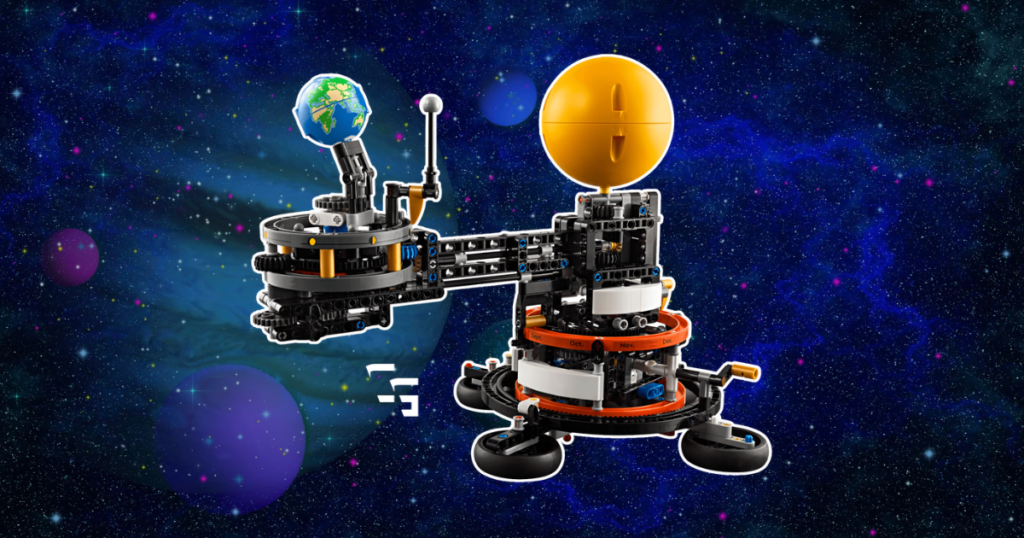
My rating: 8/10 | Built with my daughter | Approximately 2–3 hours
Some LEGO sets are fun to build. Others look great sitting on a shelf.
And then there are sets like the LEGO Technic Planet Earth and Moon in Orbit (42179), which somehow manage to turn a rainy weekend into a science lesson.
That’s exactly what happened at our house.
My wife had picked this set up on sale at some point for our oldest daughter. It had been sitting around waiting for us to build it, and this weekend, with the rain keeping us inside, we randomly decided it was time.
I figured we’d spend a couple of hours putting LEGO together, watch some shows, and have a good afternoon.
I didn’t expect us to end up:
- Researching the phases of the Moon
- Figuring out where the Moon was in its orbit
- And talking about how sunlight hits it from different angles
But that’s exactly where we ended up.
And that’s one of the main reasons I love LEGO.
After building LEGO Technic 42179 with my daughter, I’d give it an 8/10.
- It’s challenging
- It’s surprisingly satisfying to operate
- And it’s one of those sets that becomes more interesting after you’ve finished building it
It’s also not a set I’d recommend handing to a younger child and expecting them to complete alone.
Let me explain.
This article contains Amazon affiliate links. If you purchase through one of my links, I may earn a commission at no additional cost to you.

LEGO Planet Earth and Moon in Orbit: My Quick Verdict
Is LEGO 42179 worth buying? Yes, especially if you enjoy mechanical LEGO builds or want something educational to build with your kids.
The biggest selling point isn’t necessarily how the finished model looks.
It’s how everything works together.
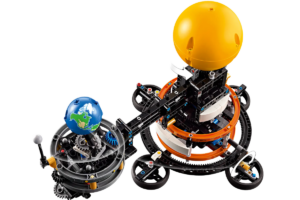
You build a series of gears that allow the Earth and Moon to move around the Sun when you turn a crank. And once you’ve finished, you can actually watch the mechanism you spent hours assembling do its job.
That’s pretty awesome.
For me, the combination of a challenging build, moving parts, and the conversations it sparked with my daughter made it worth the time.
What I loved:
- The smooth, satisfying movement of the gears
- A build that actually makes you think
- Watching my daughter get excited about the mechanism
- Learning about the Moon and Earth’s orbit together
- Having something different from a typical LEGO display set
What I’d consider before buying:
- It’s more complicated than the 526-piece count might suggest
- Younger builders may need significant help
- You have to pay close attention to gear alignment
- It’s not the best choice if you want an easy, relaxing build
My recommendation: Buy it for somebody who enjoys figuring out how things work, especially if they love LEGO, science, or building mechanical models.
Get it here: CHECK CURRENT PRICE ON AMAZON

LEGO Technic 42179: Set Details
Before getting into the build, here are the basics.
- Set Name: LEGO Technic Planet Earth and Moon it Orbit
- Set Number: 42179
- Pieces: 526
- Recommended Age: 10+
- Original Retail Price: $74.99
- Release Year: 2024
- Build Time for Us: Approximately 2-3 hours
- Main Feature: Hand-Cranked Orbital Mechanism
- My Rating: 8/10
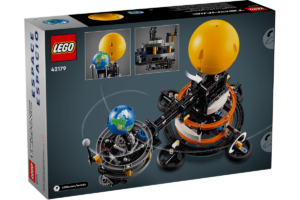
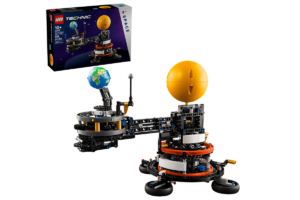
The finished model measures approximately 9 inches tall, 12.5 inches long, and 7 inches wide.
It includes a rotating Earth, Moon, and Sun, along with indicators for months and moon phases.
It’s essentially a mechanical model of how the Earth and Moon move through space.
And instead of simply showing you what happens, LEGO has you build the mechanism that makes it happen.
That’s what makes this set interesting.
Find it here: CHECK CURRENT PRICE ON AMAZON
Our Building Experience: A Rainy Afternoon With My Daughter
One of my favorite things about LEGO is that it gives us something to do together.
We build quite a bit at our house, and we’ve developed a pretty relaxed routine.
We’ll put something on TV, sit down with the instructions, and work our way through a set.
We’re not trying to break any speed records.
If it takes us a few hours, that’s fine.
That’s part of the fun.
This build took us approximately two to three hours, including our usual distractions.
But unlike some LEGO sets where you can almost go on autopilot, this one demanded a little more attention.
This Is Definitely Not a Beginner LEGO Set
Just because a LEGO set has 526 pieces doesn’t mean it’s going to be easy.
I’ve built a lot of LEGO over the years, and there were still parts of this one where I had to slow down and make absolutely sure I was doing everything correctly.
I’m 33 years old, and some of these steps almost had me losing my patience.
Not because the instructions were necessarily bad.
It’s because you’re building a mechanism.
Everything needs to work together.
And when you’re assembling a bunch of gears, the last thing you want is to get near the end and realize something was installed incorrectly 30 pages ago.
I was being extra careful about alignment throughout the build.
I’ve done enough LEGO to know how frustrating it can be to go backward through the instructions trying to find one little mistake.
So we took our time.
And I actually enjoyed that.
- I like builds that make me think.
- I like having to pay attention.
- And there’s something satisfying about knowing that you’re assembling a functioning mechanism instead of just stacking bricks.
Get it here: CHECK CURRENT PRICE ON AMAZON

Watching My Daughter Get Excited About the Gears
My daughter loved the fact that we were building gears that would eventually make everything move.
And I get it.
There’s something really cool about watching separate pieces turn into a working system.
You start with a pile of LEGO pieces.
Then you assemble gears, axles, and supports.
Eventually, you connect everything.
And suddenly, turning one little crank makes multiple things move.
That’s a pretty great payoff.
Especially when you’re building it with your kid.
I could tell she was enjoying the process, and I could also tell how proud she was once we finished.
That’s the kind of experience I want from LEGO.
Not just something that looks good when it’s done.
Something that makes the building itself memorable.
How Does the LEGO Earth and Moon Orbit Mechanism Work?
Once everything is assembled, you turn a crank on the base.
That crank drives the internal gears, creating the movements of the Earth and Moon around the Sun.
The model also includes month and moon-phase indicators to help demonstrate the relationship between the three bodies.
It’s a simplified mechanical representation, not a perfectly scaled astronomical model.
But it makes the basic movements much easier to visualize.
And the best part?
The gears on ours move incredibly smoothly.
Seriously.
Smooth as butter.
I love watching the mechanism operate because I know exactly how much work went into putting it together.
And I especially like that LEGO didn’t hide everything.
You can see the exposed Technic gears doing their job.
Some people might prefer a cleaner-looking display, but I actually think the visible mechanics are one of the best features.
Why would I want to hide the part that makes this set so interesting?
Find it here: CHECK CURRENT PRICE ON AMAZON
Is the Gear Mechanism Difficult to Assemble?
I’d say it requires patience more than anything.
The challenge isn’t necessarily understanding what you’re supposed to do.
It’s making sure everything is lined up correctly.
When you’re building something with interconnected gears, small mistakes can matter.
And because the entire point of this set is movement, you want to get it right.
That’s why I wouldn’t recommend rushing through it.
- Take your time.
- Double-check the instructions.
- And make sure everything is positioned correctly before moving too far ahead.
For us, the extra attention paid off.
Once we finished, everything worked beautifully.
Check out My Favorite LEGO Sets I’ve Built So Far

The Unexpected Educational Value
There’s a difference between buying something labeled educational and actually watching it spark curiosity.
After we finished building it, my daughter started asking questions.
- We ended up looking up where the Moon was
- What phase it was in
- And how sunlight hits the Moon from different angles
And suddenly, the LEGO set wasn’t just something we’d built.
It was something we could use to help understand what was happening in the sky.
That’s pretty awesome.
Learning About Moon Phases Together
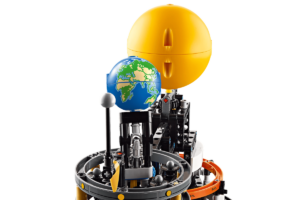
One of the things I appreciate about this model is that you can actually move the pieces to visualize the relationship between the Sun, Earth, and Moon.
Instead of just looking at a picture, we could turn the crank and watch how their positions change.
Then we could talk about what that meant.
- Why does the Moon look different throughout the month?
- How does the Sun illuminate different parts of it?
- Where is the Moon in relation to Earth?
Those are the kinds of questions we ended up exploring.
And I love that.
We weren’t sitting down for a formal science lesson.
We were just playing with LEGO.
But the curiosity came naturally.
It gives kids something physical to interact with while they’re learning about a topic that can be difficult to visualize.
And it gives parents an opportunity to explore those questions with them.
Get it here: CHECK CURRENT PRICE ON AMAZON
Is It a Good STEM LEGO Set?
I think so.
It combines several things that make STEM activities interesting.
- You’re building a mechanical system
- Seeing how gears transfer motion
- And using the finished model to explore astronomy
- You’re also learning how important accuracy can be when assembling something that needs to function
And for us, the experience didn’t stop once the final piece was attached.
That’s what I liked most.
My daughter was proud of the build, but she was also curious about what it represented.
For a set that we randomly decided to build on a rainy afternoon, that’s a pretty good outcome.
How Does the Finished LEGO Set Look on Display?
I really like it.
And I know some people aren’t going to agree with me.
Technic sets have a different appearance from traditional LEGO builds.
You can see the beams, axles, gears, and mechanical components.
They’re not always designed to look like a perfectly smooth sculpture.
But that’s part of the appeal for me.
With this set:
- I actually want to see the gears
- I want to see how everything connects
- And I want to watch the parts we assembled move together.
It looks like something we built to understand how a machine works.
Because that’s exactly what it is.
Make sure to check out 10 LEGO Gifts Adults Will Actually Display in 2026

Where Are We Going to Display It?
Right now, it’s still sitting on the table where we built it.
But I have a pretty good feeling I know where it’s going to end up.
My kids love putting their LEGO sets in the background of my livestreams.
So I’m sure this one will make its way into my streaming setup any day now.
And honestly, I’m fine with that.
It’s a cool-looking model, and it has a good memory attached to it.
That’s more important to me than having a perfectly decorated shelf.
I like having things around me that actually mean something.
And a LEGO set my daughter and I built together definitely qualifies.
Find it here: CHECK CURRENT PRICE ON AMAZON
Is LEGO Technic Planet Earth and Moon in Orbit Worth $75?
For me, yes.
Now, I can’t tell you exactly what we paid.
My wife picked it up on sale, and I don’t remember the price.
But knowing what I know now, I genuinely think it’s worth its original $74.99 retail price.
And I don’t say that just because it’s LEGO.
I’ve built enough sets to know that not every LEGO purchase feels equally satisfying.
Some builds are fun but pretty straightforward.
Others look great when they’re finished, but you don’t necessarily feel like you’ve accomplished much.
This one was different.
- It challenged me.
- It kept me entertained.
- It gave my daughter and me something to work on together.
- And the finished product actually does something.
I also think the educational value adds quite a bit.
You’re not just buying 526 pieces of plastic.
You’re buying a mechanical project that can help demonstrate some pretty interesting concepts.
And in our case, it turned into a memory.
Would I Buy It at Full Price?
Yes.
I think $75 is reasonable for the experience we had.
But if you can find it on sale, even better.
One thing I’d recommend is checking the current price before buying.
LEGO sets can become harder to find as they approach retirement, and third-party sellers sometimes charge more than the original retail price.
I wouldn’t automatically pay a huge markup just because a set is becoming harder to find.
At its original retail price, though, I think this one delivers.
Speaking of value… The LEGO Going Merry Review: Is It Worth $140

Who Should Buy LEGO Technic 42179?
I think this set is a great choice for a pretty specific group of people.
I’d recommend it for:
- LEGO fans who enjoy more challenging builds
- Kids interested in space, planets, and astronomy
- Parents looking for a project to build with their children
- People who enjoy gears and mechanical systems
- Anyone who wants a LEGO display that actually moves
- Families looking for a hands-on STEM activity
If you enjoy figuring out how things work, there’s a lot to appreciate here.
And if you’re buying it for a child, I think the shared building experience can be one of the best parts.
Who Should Skip It?
I wouldn’t recommend this as a beginner set for a younger child to build completely alone.
LEGO recommends it for ages 10 and up, but I still think building experience matters.
If your child hasn’t worked with Technic gears and mechanical assemblies before, they may need help.
And that’s okay.
I just wouldn’t buy it expecting them to open the box and finish the entire thing independently without any frustration.
I’d also skip it if you prefer easy, relaxing builds where you can almost turn your brain off.
This isn’t really that kind of set.
- You need to pay attention
- You need to make sure things line up
- And if you make a mistake in the mechanism, correcting it could take some work
Personally, I like that challenge.
But I understand why not everybody would.
How Does It Compare to Other LEGO Sets?
What makes this set stand out to me is that it’s different.
A lot of LEGO sets are built primarily for display.
And I enjoy those too.
But there’s something special about a set that has working mechanical features.
You’re not just building something recognizable.
You’re building something functional.
That’s one of the reasons I’ve been interested in LEGO sets inspired by gaming hardware and arcade machines.
In 8 Best LEGO Sets for Video Game Lovers in 2026, I covered several builds that recreate classic gaming systems, characters, and arcade experiences.
Some of those sets also incorporate moving parts, which adds another layer to the building experience.
The Planet Earth and Moon in Orbit set scratches a similar itch for me.
It’s the combination of building something intricate and then getting to interact with the finished product.
The difference is that this one also encourages you to learn about the world around you.
And after building it with my daughter, I think that gives it a little something extra.
Check out my 8 Best LEGO Sets for Video Game Lovers in 2026

My Final Verdict: LEGO Technic Planet Earth and Moon in Orbit Review
Final rating: 8/10
I really like this set.
It’s different from a lot of the LEGO builds we’ve done, and I think that’s a big part of why I enjoyed it.
- The gears are intricate.
- The mechanism works incredibly well.
- The finished model looks awesome to me.
- And I love that it gave my daughter and me something to be proud of.
But the biggest thing I’ll remember isn’t necessarily the gears or the finished display.
It’s the fact that we spent a rainy afternoon building something together, and then ended up learning about the Moon because she wanted to understand what we’d made.
That’s exactly what I want out of LEGO.
- A good challenge.
- Something fun to build.
- A finished product we’re proud of.
- And a memory attached to it.
Would I buy LEGO Technic Planet Earth and Moon in Orbit (42179) again? Absolutely.
I wouldn’t recommend it to somebody looking for a simple beginner build, but if you enjoy LEGO and like the idea of assembling a working mechanical model, I think you’ll really enjoy this one.
And if you’re looking for a gift for a kid who loves space, I’d seriously consider making it something you build together.
Because sometimes the best part of LEGO isn’t the finished set.
It’s everything that happens while you’re building it.
Get it here: SEE LEGO TECHNIC 42179 ON AMAZON