
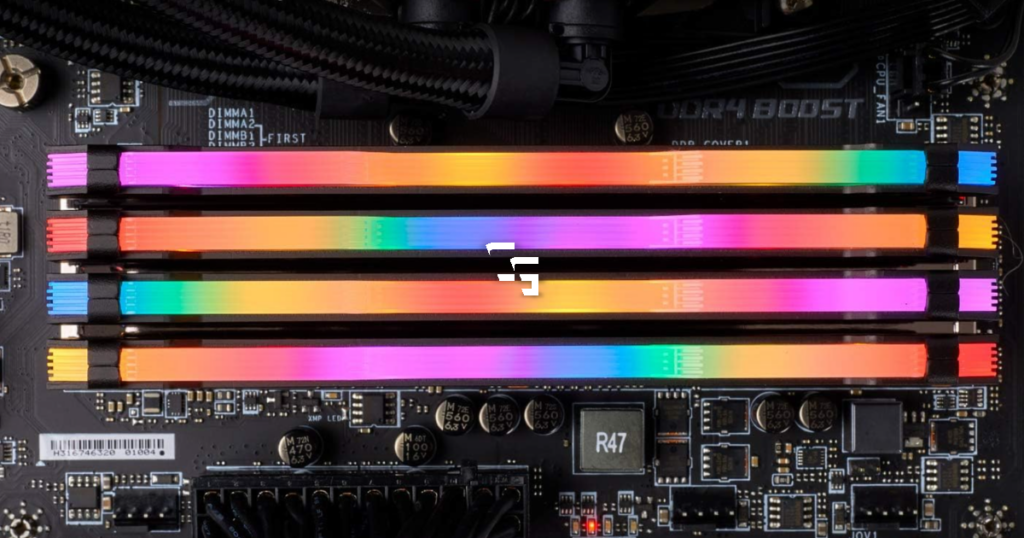
I keep seeing graphics cards advertised with 8GB, 12GB, 16GB, and even 32GB of VRAM.
For the longest time, I didn’t really pay much attention to what that meant.
- I knew my AMD RX 6700 XT had 12GB.
- I knew that was supposed to be a good thing.
- And that was pretty much the extent of my knowledge.
But after spending time researching graphics cards for ChannlerG, I started wondering how much VRAM someone actually needs.
If a graphics card has 16GB instead of 12GB, does that automatically make it better?
Turns out, not necessarily.
This article may contain affiliate links. If you purchase through one of these links, I may earn a commission at no additional cost to you.

What Is VRAM, Anyway?
VRAM stands for Video Random Access Memory.
Basically, it’s the memory your graphics card uses to store things like game textures and other graphics data while you’re playing.
Think of it like a workspace.
Your GPU does the work of rendering the game, and VRAM keeps the information it needs close by.
The more demanding the game, resolution, and graphics settings, the more VRAM it may need.
If you run out of available VRAM, you can start experiencing stuttering, textures loading slowly, or other performance problems.
But there’s a catch…
…Having more VRAM doesn’t automatically make your graphics card faster.
You still need a GPU powerful enough to take advantage of it.
A cheaper graphics card with 16GB of VRAM can absolutely be slower than a more powerful card with 12GB.
That’s why I wouldn’t buy a graphics card based on the memory number alone.
How Much VRAM Do You Need in 2026?
Here’s what I’d look for if I were buying a new gaming graphics card today.
- 1080p: 8GB can work, but I prefer 12GB if the budget allows
- 1440p: 12GB is a good starting point; 16GB gibes you more room
- 4K: I’d aim for 16GB or more on a new high-end card
These aren’t strict requirements.
Some games use considerably more VRAM than others, and graphics settings can make a huge difference.
If you’re playing older games or competitive shooters at lower settings, you might not need nearly as much.
But if you’re playing newer, demanding games with high-resolution textures and ray tracing enabled, those memory requirements can climb.
And just because a graphics card has enough VRAM doesn’t mean it’s powerful enough to run the game smoothly at your chosen settings.
That’s why I think it’s important to compare actual gaming performance, not just specifications.
I recently covered that in Best Graphics Cards for Gaming in 2026
Is 8GB of VRAM Still Enough?
Yes, depending on what you’re playing.
If you’re gaming at 1080p, especially in competitive games or older titles, 8GB can still work perfectly well.
But would I go out of my way to buy an expensive new 8GB graphics card?
Probably not.
If I’m spending several hundred dollars on something I plan to keep for years, I’d rather have a little more room for newer games.
That doesn’t mean you need to replace your current GPU just because it has 8GB.
If your games run well and you’re happy with the experience, keep using it.
There’s no reason to upgrade just to make a number on a specification sheet bigger.
What About My RX 6700 XT With 12GB?
This is where I can actually speak from experience.
I’ve been gaming on my RX 6700 XT for quite a while, and it has 12GB of VRAM.
I’ve played:
- Competitive shooters
- Story-driven games
- And streamed plenty of gameplay on YouTube
And I haven’t spent time thinking I needed more VRAM.
Now, that doesn’t mean my graphics card is keeping up with every newer GPU.
And it doesn’t mean every demanding game will run perfectly at maximum settings.
But when I eventually upgrade, I’m not going to focus on VRAM alone.
I’m going to look at:
- How much faster the new GPU is
- What features it offers
- And whether it actually improves the things I do.
Especially since I’m gaming, streaming, and recording on the same PC.
I recently compared the Best GPUs for 1440p Gaming in 2026: What’s Worth Your Money?
Should You Buy a Graphics Card With 16GB of VRAM?
If you’re building a new midrange or high-end gaming PC and can comfortably afford a good 16GB GPU, I think it’s worth considering.
Especially for 1440p and 4K gaming.
But I wouldn’t spend an extra $200 just to get more VRAM if the actual gaming performance wasn’t any better.
That’s where people can get caught up in specifications.
You see a bigger number and assume you’re buying something better.
Sometimes you are.
Sometimes you’re just buying more memory attached to a slower graphics card.
And I’d rather spend my money on something that noticeably improves my gaming experience.
My Take: How Much VRAM Is Enough?
For a new graphics card in 2026, I’d personally look for
- 12GB or more for 1440p gaming, with 16GB being a nice option if the price and overall performance make sense.
- For 1080p, 8GB can still get the job done.
- And for 4K, I’d be looking more seriously at 16GB or higher.
But I wouldn’t replace a perfectly functional graphics card just because it doesn’t meet those recommendations.
My RX 6700 XT is a good reminder of that.
It’s older, but it still does plenty of what I need it to do.
When I finally replace it, I want a meaningful upgrade, not just a bigger VRAM number.